
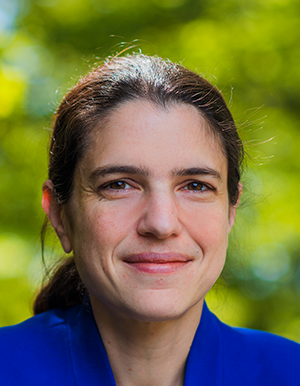
Heather Kulik, Professor, Massachusetts Institute of Technology
"How to use data in inorganic chemistry to make computational predictions a reality"
Abstract:
Machine learning in transition metal chemistry has lagged behind other areas of chemistry due to the diversity of chemical bonding associated with the challenging electronic structure of transition metal complexes. I will describe our efforts to overcome these limitations to accelerate the discovery of novel transition metal containing materials using machine learning. I will discuss how we have leveraged experimental data sets through both text mining and semantic embedding to uncover relationships between structure and function, disseminating high quality datasets of transition metal complexes with known function. I will describe how we've used these data sets to build machine learning models that predict the structure of transition metal complexes. Then I will describe how we have leveraged large datasets of synthesized materials to uncover those with novel function in polymer networks. I will demonstrate the success of our design strategy through macroscopically visible changes in network scale properties of polymers once our transition metal complexes are incorporated. Time permitting, I will discuss our work on porous metal-organic frameworks as well.
Bio:
Professor Heather J. Kulik is the Lammot du Pont (1901) professor in the Departments of Chemical Engineering and Chemistry at MIT. She received her B.E. in Chemical Engineering from the Cooper Union in 2004 and her Ph.D. from the Department of Materials Science and Engineering at MIT in 2009. She completed postdoctoral training at Lawrence Livermore and Stanford, prior to joining MIT as a faculty member in November 2013. Her research has been recognized by an Office of Naval Research Young Investigator Award, DARPA Young Faculty Award and Director’s fellowship, NSF CAREER Award, a Sloan Fellowship in chemistry, an AIChE Computational and Molecular Simulation Engineering Forum Impact Award, a Hans Fischer Senior Fellowship from the Technical University of Munich, and a Presidential Early Career Award for Scientist and Engineers, among others.